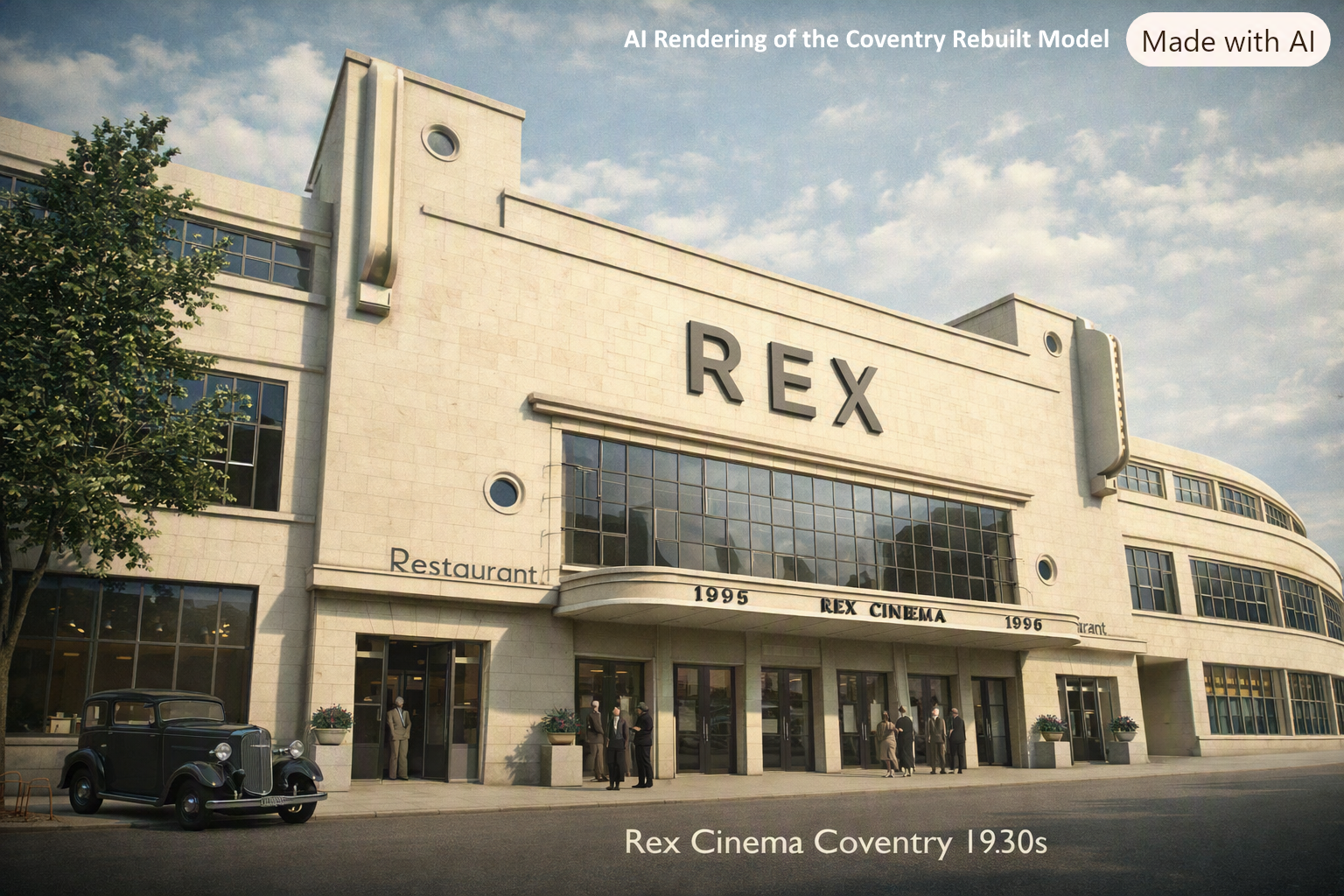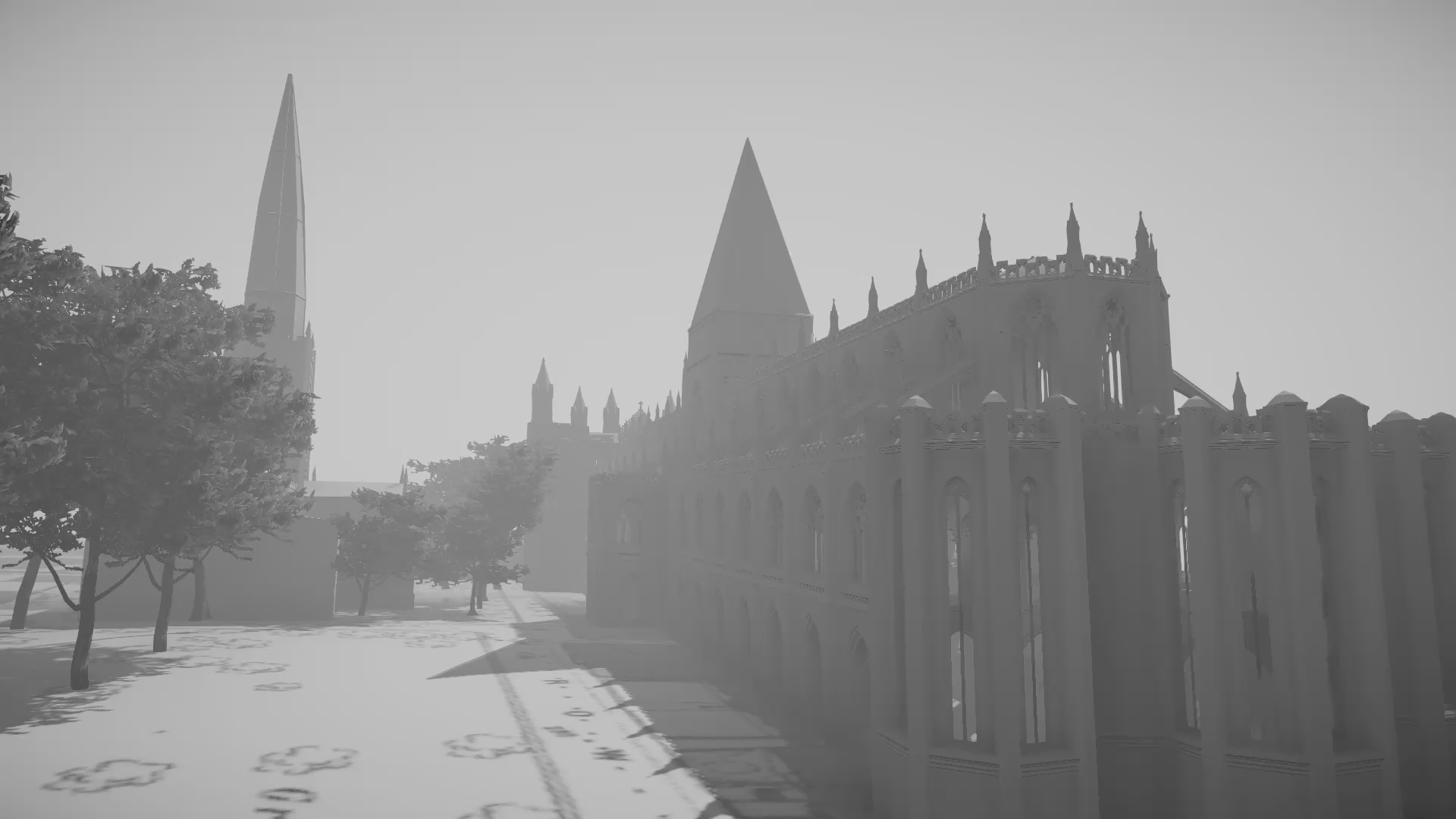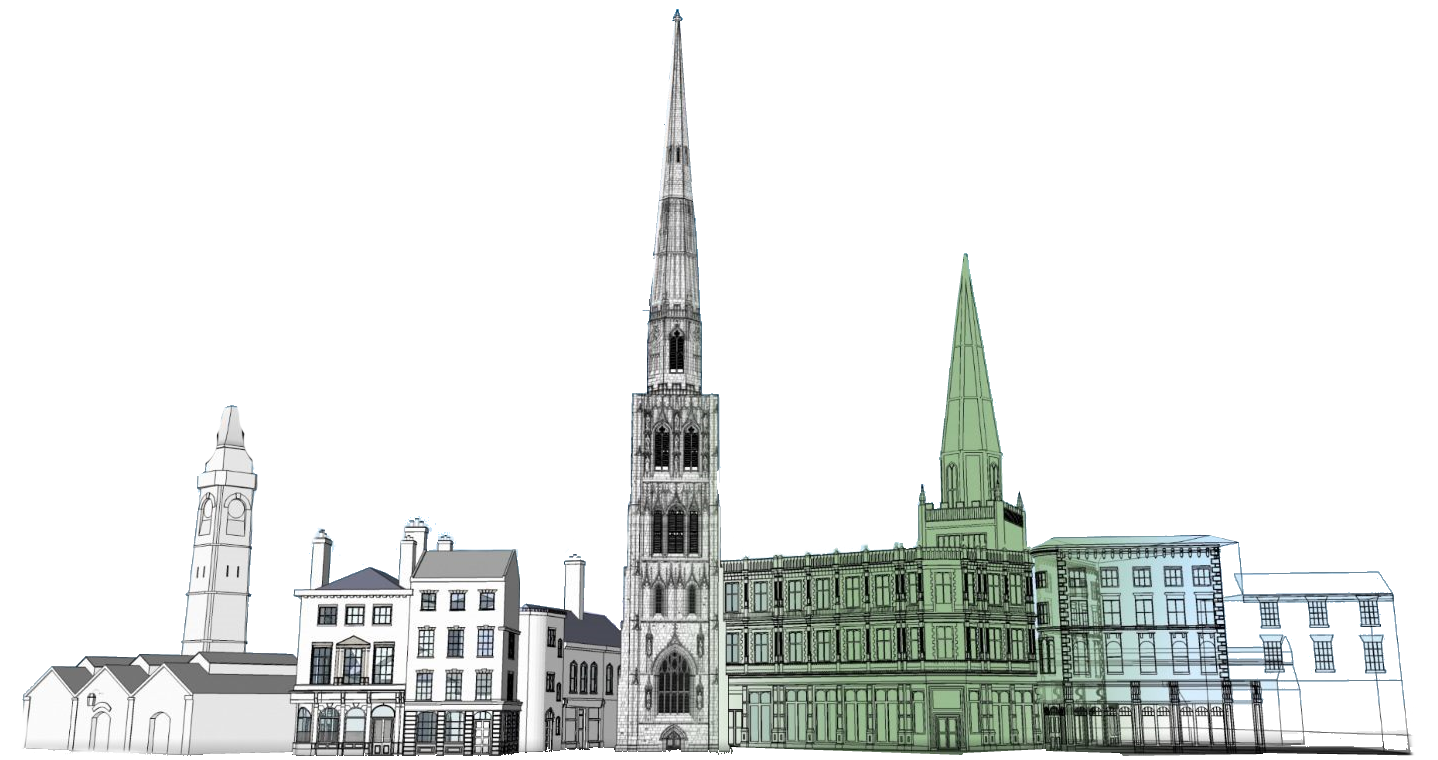

The Coventry Market Hall was built in the 1860s, complete with a clock tower. It became the beating heart of the city until its destruction in 1940.
1719 The ‘old’ Market Hall was a relatively small structure situated to the West of Broadgate, between West Orchards and Smithford Street. Built in the yard of the Peacock’s Inn, in 1719. It was known by some as Solomon’s Temple – apparently named after one of the custodians of the Market building. However important this market building was, the main market was the open air market in Broadgate.
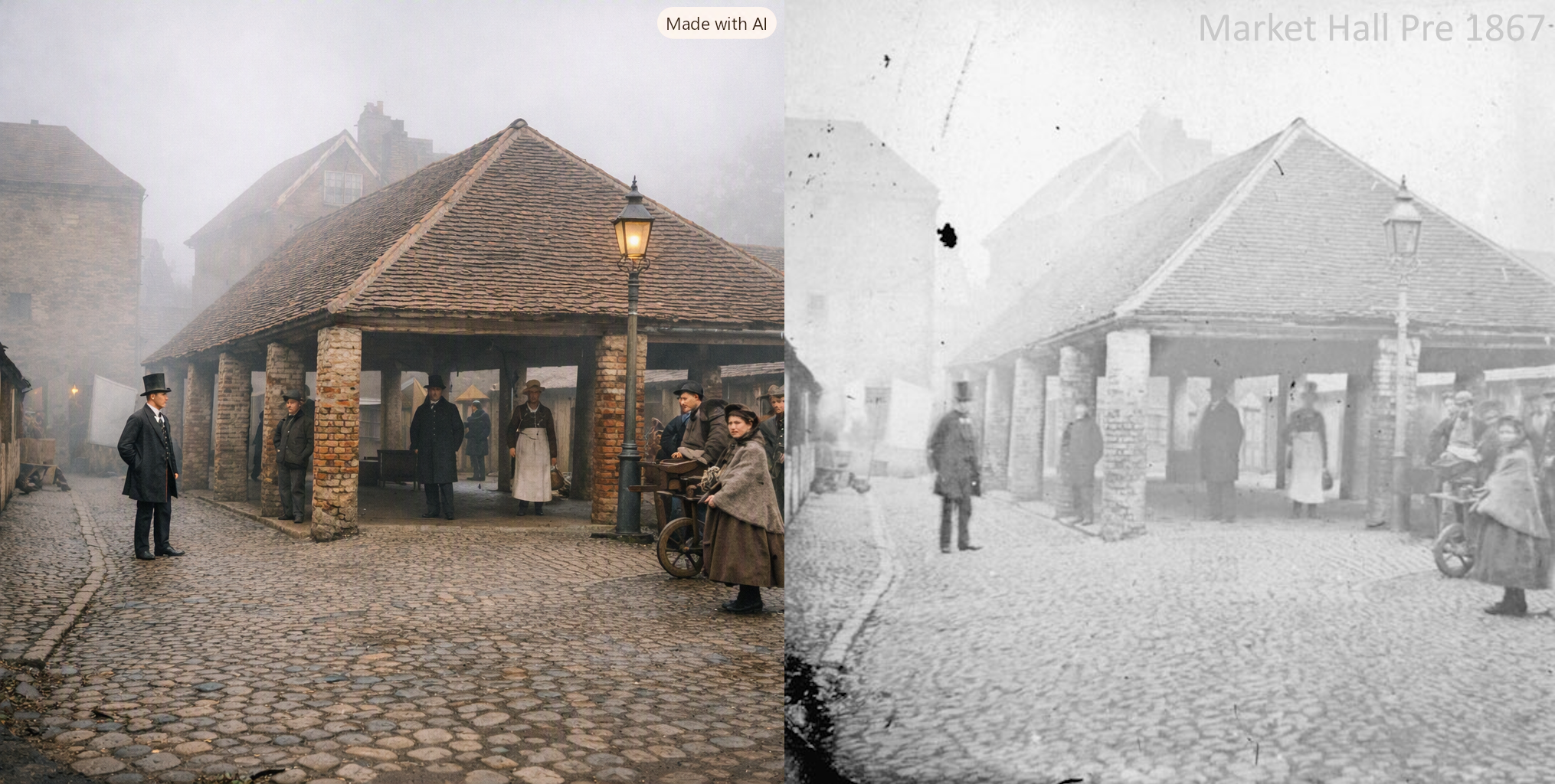
1854 – Coventry Corporation considers the idea of a new Market Hall. 1860 – Land on Holyhead Road sold off by the Corporation to fund the new Market Hall.
Alderman H Soden 1863 “The state of Broadgate on Market Days was a disgrace to the city – positively uncivilised!
It had been decided some time ago that the crockery dealers should be restricted to Market Street and the fish sellers to another part.
But lately the crockery dealers have found their way back to the centre of the town and are making a great nuisance of themselves!”
Particulars of the Process
20th August – Queen Victoria gives Royal Assent to the building of the Coventry Market Hall via the Coventry Market Hall Act 1863
1864 – The Corporation reports the cost is between £5,000 – £10,000 for the buildings, about £6,000 for the land but that excludes the property already owned by the Corporation. The Clerk then reports a figure of £25,000 to £30,000 for the whole project. [Sounds like he was making it up on the spot!].
1865 January An exhibition at St Mary’s Hall of several designs, each comprising of 7-8 drawings. They were all well received by the Corporation and the people of Coventry.
However, the winning design was modified by the Corporation to allow for a Crystal Palace style roof from the second best design. The site chosen will remove a number of old buildings that a strange to the city would hardly believe could exist in the centre of a respectable old place like Coventry.
The primary entrance to the Market Hall will be from West Orchards that will include a row of high-quality shops. The second entrance will be via Market Street. The entrance from Broadgate will be widened with the removal of the City Arms Inn. In all, this will be a marked improvement and benefit to public sanitation.
The ornamental tower, adapted from the fixing of a clock was taken from the winning design was not to be erected immediately due to cost. It may, however, be added with advantage at a future period when the town is more prosperous. It has been proposed that a time ball might be added to its extreme summit instead of the customary wind vane – the watchmakers of the city would see this as a great advantage to be in immediate communication with Greenwich.
1865 September – A suggestion of a ceremony and dinner to mark the laying of the foundation stone was put forward. The motion was not carried and so never took place.
Contract awarded to Mr W Tomlinson of Coundon – Between 1865 and 1867 the demolition and building work takes place.
Grand Opening
Wednesday 19th June 1867
The Coventry and Midland Manufacturing, Industrial and Art Exhibition
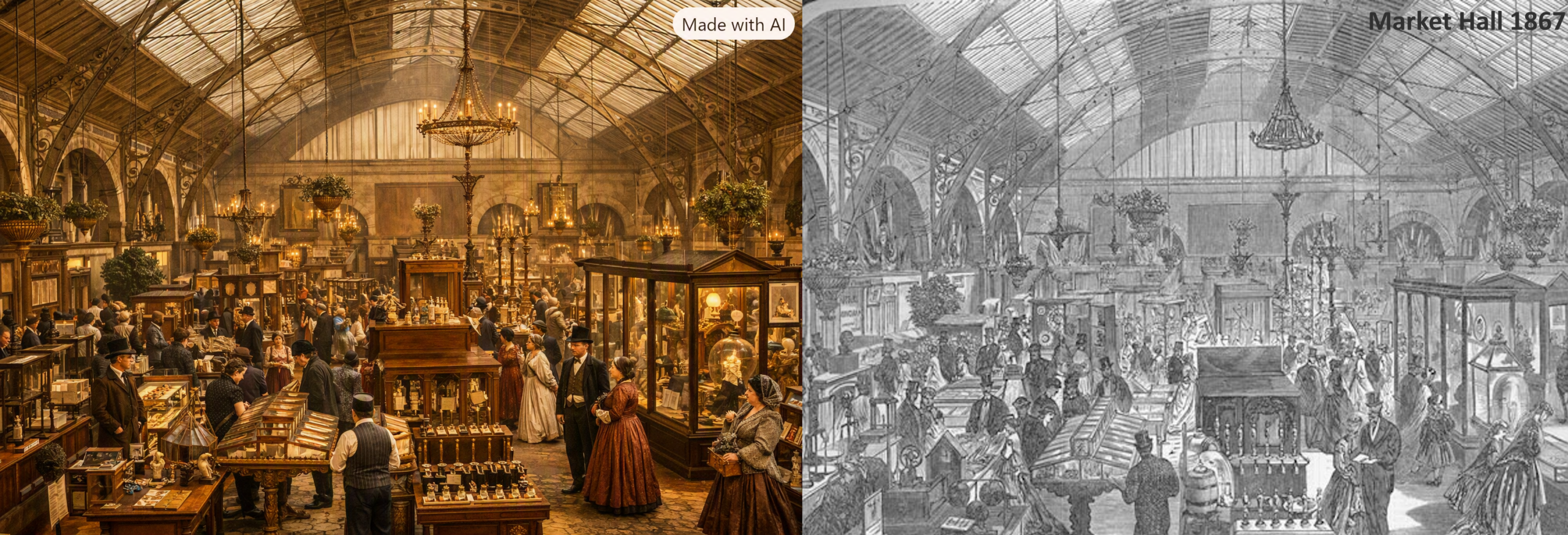
Opening Details
Local Societies & Associations are invited to take part in a procession on the opening day.
Notice to exhibitors – no goods will be received after 10th June.
Season tickets (including admission on the opening day) will be ready on and after Monday next.
They will be on sale at the Herald Office & Corn Exchange – Adults 15s, Children 7s 6d.
Exhibition includes –
Two enormous lumps of Coal from Wyken Colliery – each weighing up to two Tons will be standing against the exits.
Numerous models of buildings.
Interesting displays of natural products of minerals and fossils.
A quantity of old armour and guns from Coombe Abbey.
300 Pictures on loan from the Earl of Craven, Earl of Dudley, Earl of Warwick, Lord Leigh, Mr Bromley MP, Mr Wise MP and some treaures from Dr Dewes and Mr Gulson. Rev J W Leigh has provided a selection of water colour drawings. Mr Eaton MP specimens of Alhambra decoration taken from the Alhambra Palace.
Ancient Corporation records will be arranged in cases down the centre.
Valuable assortment of antiquities from Lichfield museum will be on display.
The celebrated Kenilworth Buffet of carved oak will be on display, which formed an attractive object in the Great Exhibition of 1851 and was afterwards purchased by the inhabitants of Warwick and presented by them to the Earl of Warwick on his marriage. [The Buffet is now at Warwick Castle]
Every Day – the fair fountain will be flowing, pipping Bullfinches & Machinery in Motion, Doors open at 10 o’clock and close at dusk.
The Exhibition will be open every Saturday afternoon after 2 pm for the WORKING CLASS at sixpence each.
[To the musical profession – a gentleman required to act as organist and pianist at the Coventry Exhibition, also six instrumentalists for the quadrille band – apply at the market hall]
Dignitaries
- Right Honourable Lord Leigh
- Lord Lieutenant of Warwickshire
- The Right Honourable the Earl of Clarendon
- K.G. James Marriott
- Esq Mayor of Coventry
- The Right Rev. the Lord Bishop of Worcester
- The Right Honourable Lord Lyttelton
- Lord Lieutenant of Worcester
- The Right Honourable the Earl of Aylesford
- The Right Honourable Earl Howe
- The Mayors of Tamworth, Lichfield, Nottingham, Derby and Stratford, Captain Adams
- Rev. J.H.Iles (Wolverhampton)
- Rev. R.H. Baynes (Coventry)
- Rev. S.H Wilddrington
- Rev. Dr Temple, Rev. A.W. Wilson (Coventry)
- Rev. E.E. Delf (Coventry)
1867
1867 July – Shilling days – Monday, Tuesdays Wednesdays, Thursdays, Fridays and Saturdays. Half Crown Days – Thursdays. Children Half Price, Season Tickets down to 10s.
August – ‘Everyone should read Mrs Brown’s Trip to the Exhibition at Coventry priced at two pence published by Mr W. Fred of Taunton’.
Exhibition Prize Medal – The committee of the Coventry Exhibition hereby offer a prize of £5 for the best design for a medal to be given o the successful exhibitors.
1st November – Starnurer Howkin – DRUNK and DISORDERLY! in Market Street – The prisoner pleaded guilty and expressed his regret for the offence. The bench discharged him with a fine of 2s 6d in the poor box.
20th November – The letting of Market Hall Shops and pitches will start at 12 o’clock promptly. The sale of ale, porter, wines or spirits will not be permitted in any part of the market hall.
2nd December – Market Traders OUTRAGE! They are now paying four times the rents they did in Broadgate. They make a request o the Mayor and Aldermen that they can trade each of the first five evenings of the month until 8 pm with the use of free gas light.
Last Open Air Market in Broadgate
Under the Coventry Market Hall Act 1863 – Any person other than a licensed hawker, who sell’s or exposes for sale in any pace in this city expect his own dwelling place or shop will be liable to be a penalty not exceeding forty shillings.
This will come into effect on Monday 2nd December 1867
1868
July – Property on Broadgate bought by the Corporation to be demolished to make a wide access to the Market.
November – The roof of the market hall is leaking. The market committee say they have painted it as best they can but can never guarantee that it will never be watertight.
September – Mr Kemp’s celebrated Hal Green Cabbage Plants available at Coventry Market Hall on Friday 21st and the following two Fridays. Orders left at the White Horse will be punctually attended to
1869
The Market Hall is struggling to make any money, with most of it empty. The Corporation suggests moving the Butcher’s from Butcher’s Row into the Market Hall. Another suggestion was to mothball the main hall and only use the outdoor area and the minor hall. Neither idea are carried out. [A white elephant in the making?]
The Market Hall – After a little joking in the city council last week in reference to the nonentity of the clock, a discussion arose as to the failure of the new market hall to attract either dealers and stall keepers, or customers, in sufficient numbers to make this grand speculation of a few years ago as remunerative as it ought to be. A suggestion was thrown out that the Butchers market might be taken into the large hall, whereby a great deal of gas and other expenses would be saved. This suggestion, however, was not thought expedient to adopt, and the discussion ended without any special result. But if the closing of the lesser Market Hall and transferring of the business to the large hall would effect a great saving of gas and other expenses, might it not be urged with still more force that the transference of the business from the great hall, and the amalgamation of the general market with the butchers’ market in the lesser hall would accomplish a still more important saving. Anyone who goes into the large hall best be aware that five days out of six it has but the merest skeleton of a market, while the other hall is quite empty. The only question is as to the Saturdays market and many people are of the opinion that retaining the shops in the arcade, with a few stalls down the centre, if necessary, the Butchers Market Hall might easily be adapted to accommodate the general market also, even on Saturdays so long as stall keepers and customers remain as scarce as they are at present, and especially considering that there is a good open space on the east side of the hall which most market gardeners would generally prefer rather than an indoor standing. We do not know what the amount of expense which might be saved by such an arrangement would be, or whether any income might be gained by other ways of appropriating the great hall, but if it be practicable, and would effect any considerable saving of expense, the idea is worth consideration. At any rate, the bringing of the entire market into one focus would get rid of the present insufferable dullness and make it lively and might ultimately attract such an attendance as to necessitate the re-opening of the great hall.
1870 Tower & Clock Opened to the Public
Mr E T Loseby won the contract for the clock and was awarded £308 10s, but owing to Mr Loseby’s desire to make the clock as perfect as possible, it is believed to have cost him in the region of £600.
A clause in the contract – for every second the clock varied over 1 second the winner of the contract would forfeit £1. The clock was to be wound once per week. The clock was finished by June 1870.
[The clock was later described as the second best public clock mechanism in the UK, second only to that of Big Ben]
1877 - 1914
1877 October – Billingsgate language that is being used by the fish stalls is untenable! Can anything be done to abate this nuisance?
1879 11th June – The Coventry Midlands Fancier’s Society – first annual meeting show of pointing and other dogs. Schedule of prizes can be obtained from Mr J W Mills 73 Little Park Street. Entries to be made by 25th May 1879.
1914 June – Post of custodian of the Market Clock – responsible for winding and regulating the clock, salary of £10 per annum. Terminable by three months’ notice on either side.
1914 Clock Watching
19th November – A group of men watched the clock awaiting the electrical signal from Greenwich, so that watches could be compared and if need be rectified. Mr Samuel Corbett of Smithford Street is in charge of the clock – along with many clocks in the Coventry area for factories and mansions. 85 steps to the clock and a further 30 to the roof where the bell is located which strikes on the hour. The summit of the tower also carries the wires which are connected to the time signal from far below.
The maker E.T. Loseby of Leicester was born in 1817, a son of a clockmaker. Bullet holes observed in the clock face – the crack from them is monitored with dates recorded next to marks – the first is 31st May 1912. The latest was recorded as the 6th June 1914, which reached the rim and is now turning back on itself. [Who knows why they didn’t like the clock to shoot it?]
Four gas lamps make the clock face visible, which are lit automatically at 6:30 pm. The clock tower is 100ft high, diameter 5ft wide, numbers are 91/2 inches, minutes are 1 1/2 inches, minutes 2ft 10 1/2 inches with a breadth of swell of 5 inches and an hour hand 2ft 1/2 inches long with a breadth of swell 5 1/2 inches. The bell is 10 cwt and is struck by two hammers alternatively, 25 lbs each, with a fall of 5 inches. The weight driving the striking part is 450 lbs and the hand motion weight is 150 lbs. Each of the large weights has a clear feet of 40 feet in eight days.
1916 August – Four boys aged nine to eleven were brought before the magistrates charged with Larceny. Arthur Edgar Longbottom (Aged 10, 6 Bully Yard), Peter Hogan (Aged 10, 17 Greyfriar’s Lane), William Ball (Aged 9, 34 Warwick Lane), Joseph Ball (Aged 9, Greyfriary’s Lane) all scholars of Chyelsmore school.
Accused of stealing twenty-seven pocket knives, three sets of feeler gauges – the property of Edward Norton, an ironmonger who has a stall in the Market Hall. Along with ten shillings worth of chocolate belonging to Thomas Herbert Glenn, who also has a stall in the Market.
The spikes on the bottom of the arcade were forded away between Thursday evening and Friday morning. The boys all pleaded guilty. The parents of the boys had acted very well and took every precaution to see that their boys told the truth.
The boys had hidden the items in a partly demolished house in Greyfriars Lane, where they had been playing. The defendants were bound over the probation of offenders Act to be of good behaviour for twelve months.
The Magistrate expressed the opinion that the Market Hall should make better protection against small boys!
1917 Fire
Peculiar fire at the market hall – Coventry fire brigade received a call this afternoon to the market hall. It appears that a smell of gas was noticed and located in a storeroom used by a grocer and situated under the hall. Someone climbed to a grating fixed over a doorway of the place, and to enable him to see into the storeroom, he struck a match. This caused an explosion which, though not injuring anyone, started a fire among the boxes. The flames were quickly subdued without much damage being done.
1924 Time Keeping
18th January – The market hall clock, which was lately stopped for a time to allow for repair to the escapement, was set going for the public use in 1870. During the elapsing 53 years it has been a splendid timekeeper, so accurate that for a man to say many years ago even that he had set his watch by it was to ensure the acceptance of the time it indicated. People, when they passed the clock, long since came mechanically to glance at it and consult their watches and decide the wager by consulting the market hall clock. At least once a group assembled in Smithford Street late at night with watches at hand and were surprised when the half hour came around not to hear the half hour strike, having been under the impression for the moment that it struck the quarters. So with all the patience they could muster, they waited for the hour to arrive. Access to the clock chamber is by steps that are broken by landings and go straight up. Each of the four dials has a diameter of six feet. One was cracked in a storm in 1916, and there are bullet holes in two of them, two in each. They were done a long time ago.
1926 State of Clock
It was reported that certain of the dials of the market hall clock are cracked and in a dangerous condition. Resolved that tenders be invited for four new dials. This appears in the minutes of the markets committee, which were confirmed by the city council this week. Two of the dials bear old bullet marks and a third was cracked during a great storm some years ago. Three of the four dials belong to the original set. Their diameters are 6ft. Lately the lock tower has been illuminated by electricity. The praises of the clock do not need to be sung. It has always been a wonderful timekeeper, none better in the land and few perhaps as good. The maker, Mr Loseby of Leicester, was apprenticed to Messrs Rotherham, his father before him having also served an apprenticeship in Coventry. Many years ago Mr Loseby wrote a letter to the Herald. Very few people in the town are acquainted with the clock’s construction or aware of its merits. But everyone is aware of its remarkable accuracy. When people pass the tower, many, as a matter of habit, consult their watches and pleased are they when they find the time is the same. Market hall time as long meant correct time. The contract to build the clock by Mr ET Loseby cost £308 10s, but owing to Mr Loseby’s desire to make the clock as perfect as possible and the difficulty of getting the work done to his satisfaction, it cost him much more than this sum. I think the total cost to him was £600. Mr Loseby’s desire to make the clock as perfect as possible was realised in the fullest sense. Mr Farmer further said there was a clause in the contract that Mr Loseby was to forfeit£1 for every second it varied over one second a day, a stipulation which, as he rightly remarks, not many makers would care to enter into. The clock was set going for public use in JUNE 1870. Few people probably have ascended the tower to the clock chamber. It is a climb that many would find sufficient. The clock is wound up once a week.
1938 Clock Malfunction
30th June: Market Tower Clock Mistry – Why does it stop?
Mr Sam Corbett, 83-year-old custodian of the Coventry Market Hall clock, is mystified. Since December last year, when the top of the 160ft tower was encased in the decorators’ scaffolding, the giant fingers of the timepiece, which is one of the finest of its type in the country, have stopped several times between 25 minutes past and 25 minutes to the hour. Yesterday, the fingers struck again at 25 minutes to five pm Mr Corbett West sent for, and he made certain adjustments, but he is still uncertain what causes the figures to catch at certain points during their hours of revolution. If the clock goes wrong again, he told the Midland Daily Telegraph representative this morning, “I shall seek a second opinion. A theory which Mr Corbett has about the probable cause of the trouble is that at some time during the work of renovation a finger on the dial facing Market Street was accidentally struck by a plank or ladder. The defect, however, cannot be found.
When the fingers stop, it affects the striking gear, but the clock mechanism continues to function perfectly as it has done with only one exception since the market hall was opened in 1867.
The mechanism is so sensitive that a common pin placed on the pendulum would cause it to gain five minutes a day. I have had charge of the clock now for about forty years, and for two years until December it never varied a fraction from the accurate time. The workmanship displayed in the mechanism is perfect. Mr Corbett said that £30 worth of quicksilver is contained in the pendulum ball.
The vital mechanism of the clock is remarkably small, measuring only about eight inches by four by three, but the gear which works the fingers and the striking device is of substantial proportions. The whole machine, bearing enclosed in a big glass cabinet, from this machine rises a shaft some 20ft long which connects with the fingers in a loft above.
Big Weights on pulleys hang down below to provide the motive power for the lock and striker. Mr Corbett, who also has access to the council house clock mechanism
1939 23rd September – Glass to be Removed from Roof – As an emergency precaution, Coventry Corporation are removing the large expanse of glass roofing from the city Market Hall, and the glass will be replaced by shuttering. The need for reconstructing the roof is understood to have been emphasised by the recent bomb explosion in Broadgate, the blast from which dislodged several pieces of glass. In an air raid, the danger of falling glass would be considerably greater. It is also realised that the reflection from a large area of glass roofing might provide a target for enemy planes, especially during a moonlight night. The shuttering with which the roof is now being covered will also serve to obscure the lights in the hall beneath.
1939 31st October – Shelter in Market Hall – it is anticipated that within a month the air raid shelter beneath Coventry Market Hall will be completed for the accommodation of nearly 1000 people. Already a section of this shelter, the largest public one in Coventry, is open, being available for 400 people. There is an emergency exit leading to the middle of the hall and the doorway being part of the ironmongers’ stall. Eventually there will be five entrances to the shelter, but the two in the hall will be available only during market times. Workmen engaged in the construction of the shelter, the vast majority of which consist of Old Market Hall storerooms, say that it is as safe as anything. The minimum thickness of the roof consists of concrete brick, and the market hall floor is three feet, and in some places the depth of the roof is seven feet
Market Hall hit by high explosive bomb 1940 26th August
1940 26th August – (Same night of Rex cinema bombing) The local fire brigade was called on to deal with fires, the most serious of which was at Market Hall buildings. The fire there started immediately after the building had been hit with a high explosive bomb. The fire brigade was quickly on the scene, and as there was no hope of saving the building, they confined their activities to preventing the spread of the flames to surrounding shops and a nearby fish market. Several incendiary bombs fell near the suburban sports ground, and a serious fire was started, but here again the brigade was able to prevent the spread of the flames to surrounding buildings.
1942 The fate of the Market Hall Tower
1942 19th August – Since the devil’s disciples have been unsuccessful in destroying the Market Hall Tower, it would seem that other minds are bent on bringing it to the ground. This finely built campanile is the only memento we have left to remind us of colourful times and the English hours of happiness we used to find at the top of the town. Gone are the old-time features of Cross Cheaping and Broadgate; it is like robbing a graveyard of its last great monument to the dead. If our Market Hall Tower is to be demolished merely for the sake of proving a few extra square feet of space for a store, then sharp criticism and keen feeling will cut across this civic blunder as with a knife.
1942 27th October – Market Tower doomed, final motion to demolish the tower carried 24 to 15.
1942 Letters for and against demolition of the clock tower
Sir, many of the letters concerning the market hall tower savour of sentiment. The tower itself has no beauty or historic value, and as such is useless; it actually does come within the scope of the new development without being an eyesore, and should be pulled down. The clock, however, is a different proposition, and I appreciate the sentiment attached by those who made it and would suggest that it would be seen at its best as the centrepiece of the new guild hall in the Coventry of the future.
Sir, I much admire Mr Abe Jephcott’s literary efforts and his sentiments regarding the market clock tower. It must be borne in mind, however, that future generations will have no interest in the past associations of the clock and the Coventry watch marking industry. From the practical point of view, the tower is not worth preserving for beauty’s sake, and it would be an obstruction to post-war town planning. It must be remembered that if every little community of people had its own totem pole preserved for ever, then England would be full of useless monuments which would be an economic burden that could not be supported. If we are to progress, we must cut a lot of bonds which tie us to superstition, habit, custom and tradition.
Sir, Sentiment aside for the moment, this red-brick tower built in English brick and inlaid with ornamental courses of buff and blue is of no mean stature. With a balcony of fine ironwork and bell-tower rightly balanced on arched cornice, it is not unpleasing to the eye. The Victorians could build a tower to vie with the best of any age. How this splendid tower can be an eyesore to anyone I cannot in any way comprehend. In the midst of all this controversy, the tall timepiece stands supremely alone, like patience on a monument, smiling at grief. It is not in the way of traffic; it is not hurting anyone. Citizens make a stand for old times’ sake and the tower. Yours truly, ABE Jephcott.
1942 Summary of the Market Hall
1st April 1942 – The market hall was opened in 1867, and including the market square, there used to be 82 shop tenants, 64 stall holders and 23 ground tenants, representing a fairly extensive shopping centre in the heart of the city. All this today is a waste area piled with the debris of the bombed buildings. While the market hall tower will disappear, the famous clock will remain for incorporation at some future date in some new building erected in Coventry reconstruction. [The clock in Broadgate is the clock from the Market Hall Tower]
1942 November 13th – Council seeks tenders for demolition of clock tower.
Paper Defends Itself
1942 November 14th – Further to our recent notes in regard to the fate of the Coventry Market Hall Tower, we have been rather harshly accused of being prone to vandalism. That, of course, we deny, for there have been no greater advocates of the duty of keeping that which is committed to their trust than this newspaper. We believe, however, that the injunction in this respect refers to things of definite value to the community – value that is to be found in ancient monuments, in which category the market hall tower does not come. In things handed down from the past which have historic interest, which this tower has not, in things which bring their lesson from which something can be learned for the benefit of the people of today. We too would wish the tower to stay if possible, but not if it stands in the way of something more desirable, of something which would be to the benefit of the city and its people. We must hope that the city council has acted wisely in refusing to allow the matter to be reopened. The fact that there was a majority feeling in this direction must be taken as evidence that the preservation of the tower it not generally considered necessary.
Brick Preservation
Suggestion to the local paper that every Coventry person who campaigned for its preservation should be presented with a preserved brick on its demise. [No evidence to suggest this happened]
Move the Clock Tower?
1942 September 3rd – Some time ago, there appeared in your paper a letter which I think voiced the sentiments of most Coventry people regarding the market hall tower. We feel it is part of the old city and a true link with the past. As the site is required for reconstruction, might I suggest that the tower be carefully taken down and re-erected with its old clock on some other suitable spot. It could be known as the tower of memory. In memory of those citizens who lost their lives in Coventry’s great blitz.
1942 September 5th – Sir, I was amazed to note that one of your correspondents advocated the preservation of the Market Hall tower for subsequent re-erection. Surely the coming peace will bring with it something in the way of progress! Don’t let the successful replanning of the city be fettered by old-fashioned ideas or sentiments. Coventry will take, perhaps, ten years to rebuild and we must try to think that much ahead. The city must be planned as a unified whole and not consist of several sporadic items of obsolete architecture belonging to an era that the future generations will do well to forget. I know that the olde Coventry inhabitants will not take this view, but this city is to be rebuilt for our youth. It must contain no gloomy reminders of these days. It must be planned for the future; no compromise is possible, and the new Coventry should be an inspiration to the rest of the ravaged cities of the world
Council Action?
1942 October 26th – Market Tower to go? Cllr A.T. Randle seeks to rescind an order to demolish the market tower until the redevelopment of the city begins. Calls for the tower to be saved until at least the redevelopment of the city starts in full swing. Demotion understanding order no 16.
Fed Up!
1942 December 9th – Why all this bother about the market hall tower? I am quite sure the average citizen is thoroughly sick of the whole affair. The sooner it is pulled down and forgotten, the better!
More Letters
1942 December 14th
Sir, A subject all of which I thoroughly endorse as coming from the citizens who have their city at heart and not like some of the latecomers who have not a thought for the past. I am one of Mr Bills fraternity, well recollecting the hall being opened in June 1867 as a trades exhibition and in the following December for public trade. The tower was built later. As I see no reason at present why the tower should be demolished, my suggestion is that it should remain as a memorial to those who lost their lives and those who were injured in the great blitz of the city of November 1940. Arthur E Astley 18 Stoneleigh Avenue.
Sir, until I read the hysterical remarks by Mr J Heritage, I did not know that the gentleman himself was the sole arbiter of thought on the reconstruction of our city. He avers that a complete answer to all controversy on that subject is given in the BBC feature Coventry looks ahead, and being conclusive to himself on this, he then exhorts the city architect to proceed with the good work of getting something ready for the year 1990! How very charming and easy withal? No, Mr Peters, the broadcast did not thrill everybody into that strange state of mind. The radio gave us a patchy little play of colourful Coventry from the human side. It could be classed as entertainment rather than educational. The bit of buffoonery popped into the script for propaganda purposes had to do with the market hall clock tower. It was well timed, just in production, but showing nothing but a pantomimic effort to destroy a monument. Shall we see to it that the market hall tower is not destroyed merely to satisfy the fad and fancies of dictatorship? Yours, Claire Jephcott
1942 December 17th
Passing of the Tower – The correspondence about retaining the market hall tower seems to have developed into a serial story, a serial suitable for children, judging by the childish mentality which we read in their letters. How any person can put a halo around a few bricks and mortar is difficult to conceive. The most outstanding memory to me of the market hall tower is the strong odour of fish in a congested area. Some of your correspondents wish the tower to be retained as a reminder of the Blitz, but a few folks I know, with their nerves almost shattered through the raids, would give a lot to forget all about the raids and possess some sweeter memories. I think it would be much better if your correspondents who want the tower to be retained would live less in the past and think more of the future. Sweet memories are good, but memories filled with horror are best erased from our minds as quickly as possible. Thanks to the council for their decision.
Things are getting heated
1942 18th December
Sir, to all who would defend the tower against the wicked people who would destroy it, may I outline a plan: 1 – A picked body of men should size the tower. This being done, a lag should be flown from the top when all other armed supporters should make their way thither. 2 The approaches to the tower should be mined and guarded. Picked sentries with an ancestry going back at least as far as the days of the watch trade should watch the tower night and day and open fire on anyone approaching the tower with intent to damage it. Only this will this glorious souvenir be saved – Your frivolously A Martin
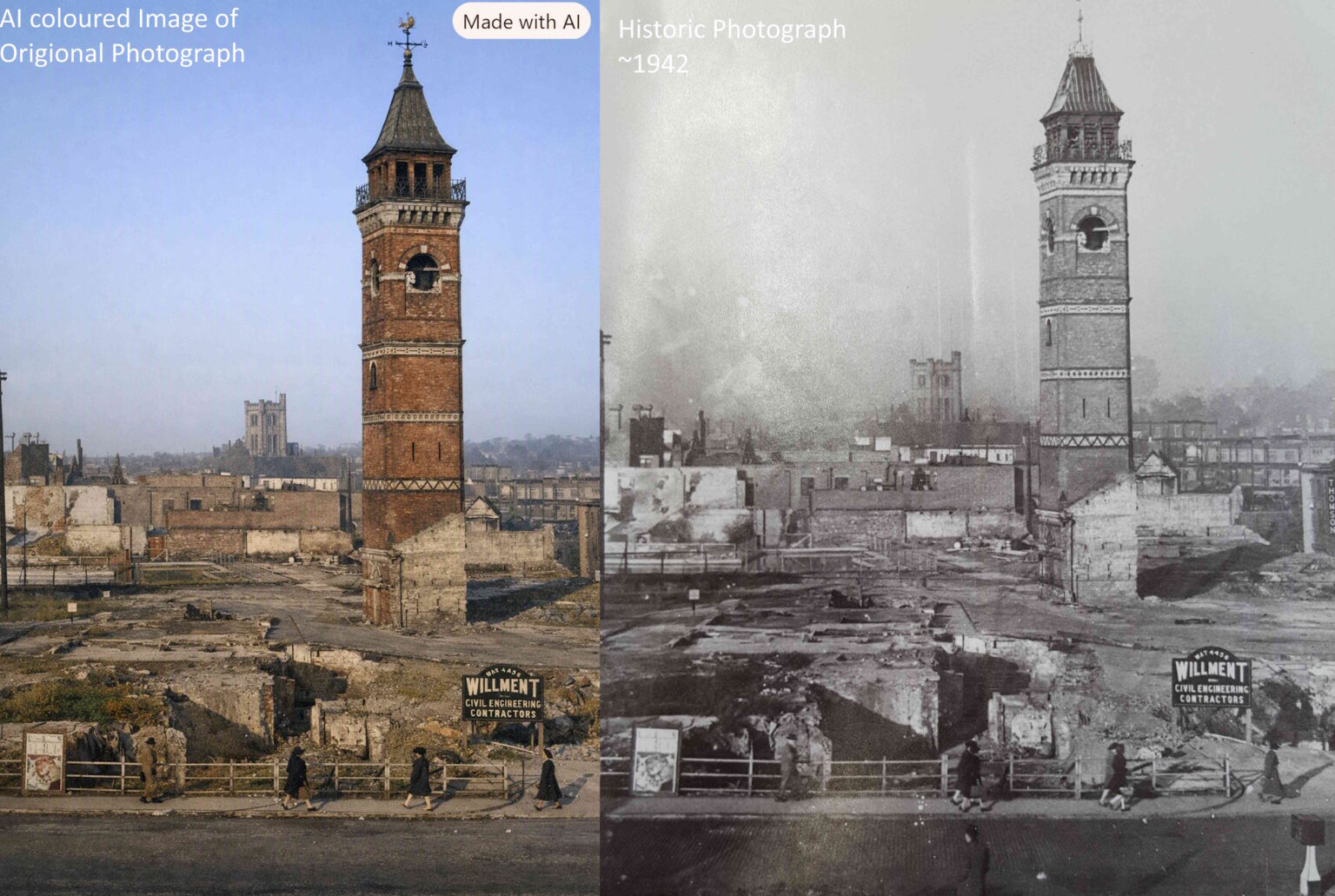
End of the Clock Tower – 1942 December 21st
The appearance this morning of dark figures ascending ladders leading to the highest point of the much-discussed market hall tower and starting work on the base of the weather vane meant the end of the last-minute hopes of some Coventry people that the structure might be saved as a relic of old Coventry. It is expected that in a month (weather permitting) the tower will be only a memory. The demolition contractors, Messrs Walker and Flangan have engaged a Leicester firm of steeplejacks to take down the vane and the gable roof at the top of the tower. They will also unhang the 25cwt bell and lower it through the various floors to the ground level. It will probably be necessary to enlarge the well holes in the floors to get the bell down. Zinc in summit – it was found that the summit of the floor was sheathed in zinc, under which there is probably a layer of copper. One of the first articles to be removed was the big old wooden box stored in the rafters in which the vane used to be packed when it was taken down for regilding. The vane itself, which will be preserved, will probably be lowered over the side of the tower by means of rope and tackle. It is interesting to note that Mr Trevor Neville, son of Mr Herbert Neville, principal of the firm of steep jacks, claims to have been the youngest steeple jack in the world. He was taken up the spire of Hinckley parish church by his father when he was only nine months! Mr Neville junior is now 21 and this morning was at work loosening the base of the vane.
1942 December 30th
DEATH
Market Hall Tower Tragedy Inquest – A 12-year-old boy described to the Coventry coroner yesterday how he and his friend of the same age went under the railing near the market hall tower and walked toward the tower. A piece of timber fell from the top onto the head of his friend, causing fatal injuries. The inquest was on Peter Bullivant (12) of 664 Sewall Highway, Coventry, who died in hospital on Sunday night following the accident on Thursday. Bullivant’s friend said that he had been up the tower on two occasions, and on Thursday they got under the railings in Smithford Street and went towards the tower; they did not know it was being demolished. When they got under the tower, a man waved to them from the top. A witness called to Bullivant to go back, but he lay under some timber which had fallen from the top of the tower. A steeplejack, George Henry Keeling of Leicester, described how he saw the children under the tower and waved to them to go back and shouted to them. He then lost sight of them. He dislodged a piece of timber about 6ft by 2ft which fell to the ground. Recording a verdict of Accidental Death, the coroner, Mr C.W. Iliffe, said that it would be practically impossible to keep people away from the tower site who were determined to get in. There was no negligence on the part of the workpeople.
1953 January 21st The old Market Hall clock bell was hoisted into position this morning on the east side of the new clock site on the bridge of Broadgate House. The clock works will be installed when the constructional work is nearer completion
1961 November 1st – Mr S Shaw, senior assistant at the Herbert Art Gallery and Museum, examining the hands of the old market hall clock. The hands had been stored since the demolition of the clock tower in 1943 at the Derby Clock firm. The hands are made of copper and are 2ft 10 /12 inches long. Each hour hand is 2ft ½ inches long. The clock tower was 100ft tall. The clock was set ongoing for public use in June 1870. During tests over nine months during 1888, the greatest variation on the mean daily rate, compared with the Greenwich clock, amounted to only 0.2 of a second. Over a period of 20 years, checks showed that the clock’s one o’clock signal agreed absolutely with Greenwich. The clock mechanism used in the Broadgate clock, along with the bells – the hands were forgotten about.